













Contents
A team win total bet is a wager on whether a team finishes the regular season above or below a number of wins the bookmaker sets, such as 56.5 wins in an 82-game NBA season. By ToolsGambling's calculation, if every game has the same win probability, the Over 56.5 price of -141 breaks even at a 58.5% probability, which requires winning about 70% of games. The line and prices come from a 2024 snapshot, and each bookmaker's rules can differ. The key assumption is one equal win probability in every game: at 65% per game, a line of 55.5 instead of 56.5 gives a 30.8% probability against 23.1%.
Key takeaways
- Over 56.5 requires the team to finish the regular season with 57 or more wins.
- The -141 price implies a 58.5% probability, not an independent forecast of the team's result.
- A stake of 141 at -141 produces winnings of 100 and a total payout of 241 if the bet wins.
- Exactly 45 wins on a line of 45 can produce a push under the bookmaker's rules, whereas an exact match is impossible on a line of 45.5.
What a team win total is
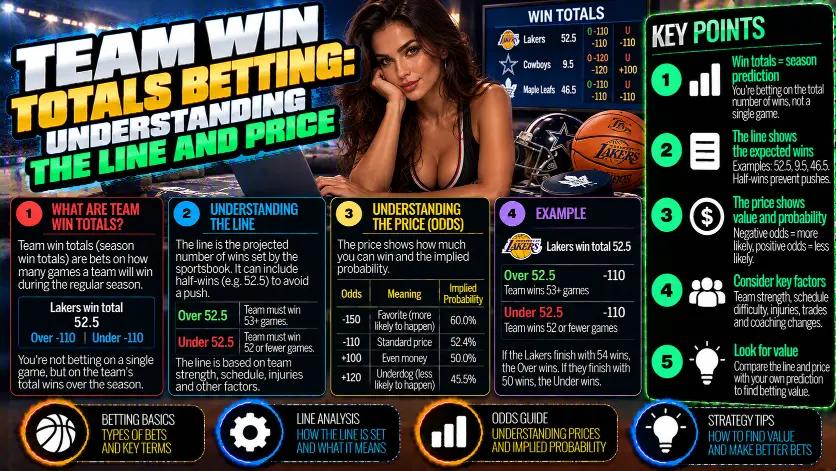
A team win total is a threshold against which you choose Over or Under on a team's final regular-season win count. The line tells you what result qualifies; the odds tell you the payout for that result. You need both parts to understand the offer.
The half-win in 56.5 does not suggest that a team can record half a win. It separates whole-number outcomes. Over requires 57 or more wins, while Under requires a total below the line. There is no possible final win count equal to 56.5.
The market covers the regular season, not a bet on an individual game or a team's playoff performance. A team can perform well in ordinary basketball terms without meeting the particular condition attached to its season bet. Being positive about a team is not the same as judging its line and price attractive.
The historical example is Oklahoma City Thunder Over 56.5 wins at -141, from Pinnacle, NBA Team Win Totals Betting Preview (17 Oct 2024), recorded in the snapshot dated 29 Oct 2026. It is an example for explaining a price, not a current offer or a prediction about Oklahoma City.
Team win totals belong to futures: settlement depends on the season's outcome rather than the next game. That longer horizon does not change the basic task. You still need to identify the result being bought and the payment attached to it.
Teaching diagram: a 56.5-win line splits outcomes into over and underTeaching diagram: a 56.5-win line out of 82 games
How to read the line and the price
Read the line and price together: Over 56.5 at -141 means backing 57 or more wins at the payout specified by -141. Start with the qualifying result, then examine the price. The minus sign does not tell you how many games the team must win.
What -141 and +101 mean
Negative American odds show the stake required to produce winnings of 100; positive American odds show the winnings from a stake of 100. In both cases, winnings exclude the returned stake. The total payout includes both.
At -141, a stake of 141 produces winnings of 100. At +101, the positive number describes winnings relative to a stake of 100. Neither sign identifies the direction of the bet: Over and Under can each have positive or negative odds.
The same Pinnacle preview lists Minnesota Over 52.5 at +101, Memphis Under 47.5 at -117, and Miami Over 44.5 at -130. These are separate examples, not competing prices for the same result. Their different lines matter just as much as their different odds.
Our explanation of how betting odds work covers the American format in more detail. The distinction to keep here is between winnings and the total payout; waiting for a season to finish does not change how the price is read.
Turning the price into a probability
The implied probability of -141 is 58.5%, which is the break-even win rate for this bet without a push. It describes the probability required by the price, rather than a basketball assessment of the team's prospects.
The ToolsGambling implied probability calculator converts a single price into its implied probability. Converting -141 gives 58.5%; it does not evaluate a roster, schedule, or future season. The conversion and the sporting estimate are separate tasks.
For the other historical examples, +101 implies 49.8%, -117 implies 53.9%, and -130 implies 56.5%. These percentages make the prices easier to interpret. They do not establish which team offers the better bet, because each price applies to a different season outcome.
To assess the margin in an Over / Under pair, you need the prices on both sides of the same line. The margin calculator addresses that calculation. The single Over price of -141 is not enough to identify the margin across the pair.
The guide to how to remove the bookmaker margin continues from those two prices toward a fair-price estimate. That estimate depends on the quoted odds and the method used to allocate the margin; it is not proof of the outcome's true probability.
How the payout and the refund work
A winning bet returns the original stake plus winnings; a losing bet loses the stake; a push returns the stake without winnings. These are different settlement outcomes, even though both a winning payout and a push involve money being returned.
The stake table
A stake of 141 at -141 produces winnings of 100 and a total payout of 241 when the bet wins. All amounts below use the same monetary unit, so no particular currency is needed to explain the relationship.
| Stake | Winnings excluding returned stake | Total payout including returned stake |
|---|---|---|
| 141 | 100 | 241 |
Payout diagram: a 141 stake at -141 wins 100 and pays a total of 241ToolsGambling calculation at -141 from a 2024 snapshot
The 241 is not net profit. It includes the original 141 stake, so the profit on this successful bet is the 100 in winnings. Keeping those amounts separate makes a payout statement easier to read.
Per unit staked, the winnings at -141 are 0.709. That figure is rounded and is used below to explain expected value. The payout table describes what happens after a win; it says nothing about how likely that win is.
A whole-number line and a push
A push on a whole-number total can occur when the final win count exactly matches the line and the market's terms provide for a refund. A line of 45 therefore has distinct outcomes above, below, and exactly on the threshold. A line of 45.5 cannot be matched by a whole-number win count.
The general distinction between half-point lines and a push is described in legalsportsreport.com, push guide. An exact match is different from a successful Over or Under bet: it returns the stake rather than producing winnings.
Our calculation for a line of 45, using an equal 50% win probability in every game, gives a 6.0% probability of exactly 45 wins and a 16.0% probability of more than 45. At an equal 60% per game, those probabilities are 5.7% and 79.8%, respectively.
If the equal per-game probability corresponds to an average of 45 wins from 82 games, or 54.9%, the probability of exactly 45 wins is 8.8%. An average matching the line does not mean the team must finish on it. The average summarizes a range of possible season results.
A whole-number line therefore needs a break-even calculation that treats refunds separately. A push creates neither winnings nor a lost stake. The 58.5% threshold from the half-point example cannot simply be transferred to a bet with a refund outcome.
The break-even point: ToolsGambling calculation
At -141, the probability of winning the season bet must reach 58.5% to break even. This is not the percentage of games the team needs to win. Connecting those quantities requires calculating the probability of the final win count.
Required probability per game
Under the equal-probability assumption, Over 56.5 at -141 requires a 69.9% win probability in each of the 82 games. That corresponds to an expected 57.3 wins and a 58.5% probability of finishing with 57 or more. Our calculation was checked in two ways, with both matching 58.5%.
The expected win count and the probability of clearing the line answer different questions. An expectation of 57.3 is an average across possible seasons, not a forecast that the team will finish with that precise total. The bet depends on all the probability above the threshold.
Our calculation uses a binomial distribution of wins, with the same win probability in every game and games treated as independent of each other. The figure of 82 games is a ToolsGambling assumption about the NBA regular season; we did not retrieve a primary source for it for this calculation. This provides a way to translate a per-game probability into a season-outcome probability. Figures are rounded as displayed, so they should not be treated as unrounded values for further precision.
Under these assumptions, about 70% per game is needed to make the probability of 57 or more wins reach the price's break-even threshold. It is not merely the probability needed to make that result possible. Possibility, expectation, and break-even probability are distinct concepts.
Sensitivity
Moving the line by one win can materially change the probability of winning the bet without changing the assessment of the team. At an equal 65% per game, Over 56.5 has a 23.1% probability, while Over 55.5 has a 30.8% probability—a difference of about 7.7 percentage points.
The lower line adds another possible final win count to the successful outcomes. The size of that addition depends on how much probability lies near the threshold. A one-win difference is therefore not automatically a minor change.
The sensitivity figures answer a different question from the 69.9% calculation. There, we sought the per-game probability needed to reach break-even. Here, we hold the per-game probability at 65% and compare the results for different lines. That 65% is per game; in the expected value section, 65% is the probability of winning the whole season bet, which is a different quantity.
Line shopping means comparing prices at different bookmakers for the same line under equivalent settlement rules. On the same 56.5 line, -110 instead of -141 lowers the break-even win rate from 58.5% to 52.4%. At a true season-bet win probability of 65%, expected value per unit is +0.241 rather than +0.111. If the line changes as well as the price, the qualifying result has changed, so comparing odds alone is insufficient.
Expected value at different probabilities
Expected value is the average mathematical result per unit staked at an assumed true probability of winning the bet. It combines winnings when successful with the lost stake when unsuccessful. It is not the amount a single bet will necessarily return.
At -141, our calculation gives:
- A true bet-win probability of 55% produces expected value of -0.060 per unit.
- A true bet-win probability of 60% produces expected value of +0.026 per unit.
- A true bet-win probability of 65% produces expected value of +0.111 per unit.
The percentages above refer to winning the season bet, not winning an individual game. Substituting a per-game probability here would confuse two different events and would not evaluate the intended wager.
Positive expected value is conditional on the assumed probability being accurate and exceeding the price's threshold. Correct payout arithmetic cannot establish that probability. An error in assessing the season can change the sign of the result, which is why these examples explain a calculation rather than promise profit.
What breaks the calculation
The calculation stops describing the situation reliably when the probabilities change or the settlement terms differ from those assumed. Changes to the team affect the sporting assessment; market terms govern how the bookmaker settles the bet. Those are separate issues.
Injuries and roster changes
Injuries and roster changes can alter the probability of future wins, making an earlier season estimate outdated. Their relevance also depends on how much of the remaining schedule is affected, rather than simply whether a player appears on the roster.
The equal per-game probability is the main simplification. Real opponents differ in strength, and a team's own condition can change during the season. Real teams' final win totals are usually more widely spread than in this simplified calculation, changing probabilities near the line, the chance of an exact hit, and the per-game probability needed for break-even.
New information can also move the offer itself. A line change alters the qualifying result; a price change alters the payout for the existing result. An updated offer should not be treated as equivalent to the old one without checking both parts.
The practical question is whether the assumptions behind an earlier estimate still hold. A previous probability does not remain suitable merely because the market still concerns the same team.
The bookmaker's rules
The bookmaker's rules determine which results count and when the bet is settled or refunded. A general explanation of Over and Under does not establish every condition for a season market.
Before placing a bet, find the answers to these questions:
- Do only regular-season wins count?
- What happens if the season or schedule is not completed?
- What provisions apply to postponed or cancelled games?
- How is an exact match on a whole-number line settled?
- Are there separate conditions for this particular futures market?
The list is a set of checks, not claims that all bookmakers apply the same exceptions. If a term is unclear, do not substitute a general push explanation for the actual rule. The legalsportsreport.com push guide does not describe season futures conditions, so check the specific bookmaker's rules.
Stake size is a separate decision from whether a price looks attractive. The bankroll management guide covers allocating money to a long season market. A probability calculation alone does not determine an appropriate stake or account for other financial commitments.
Summary: what ToolsGambling calculates
ToolsGambling converts a price into implied probability and shows the assumptions needed to reach it. By ToolsGambling's calculation, if each of the 82 games has the same win probability, Over 56.5 at -141 has a 58.5% break-even threshold, requiring 69.9% per game and an expected 57.3 wins.
| Quantity | Result |
|---|---|
| Implied probability at -141 | 58.5% |
| Per-game win probability required for break-even | 69.9% |
| Expected wins at that probability | 57.3 from 82 |
| Probability of Over 56.5 at 65% per game | 23.1% |
| Probability of Over 55.5 at 65% per game | 30.8% |
| Break-even win rate at -110 on the same line | 52.4% |
| Expected value at -141 with a 65% bet-win probability | +0.111 per unit |
ToolsGambling calculation, 29 Oct 2026
To understand the price, separate the decision into three questions: what result does the line require, what payout do the odds provide, and how probable is that season outcome? The first two come from the offer. The third requires assumptions. Under these assumptions, the calculation supplies a comparison point—not a team prediction.
Frequently Asked Questions
It is a bet on whether a team finishes the regular season above or below the bookmaker's line. Over 56.5 requires 57 or more wins.
These American odds mean a stake of 141 produces winnings of 100, excluding the returned stake. The total payout on a winning bet is 241.
The implied probability is 58.5%. This is the break-even win rate for a bet without a push, not a verified probability of the team's result.
Exactly 45 wins on a line of 45 can produce a push, with the stake refunded, if the bookmaker's rules provide for it. A line of 45.5 cannot match a whole number of wins.
An average alone is not enough; you need the probability of finishing with 57 or more wins. In our calculation, breaking even at -141 requires an equal 69.9% win probability per game and an expected 57.3 wins.
At an equal 65% win probability per game, Over 56.5 has a 23.1% probability, while Over 55.5 has a 30.8% probability. A lower line therefore cannot be assessed by its price alone.
They can change the probability of winning remaining games and make an earlier estimate outdated. The effect on an existing bet is governed by the bookmaker's rules.
Check which games count, what happens if the season is incomplete, and how an exact match on a whole-number line is settled. A general explanation of a push does not establish the terms of a particular season market.
Evgeniy Volkov
Verified ExpertFullstack developer with a background in mathematics. I build the calculators and game-style tools on ToolsGambling with Pixi.js and modern web tech, and every result uses transparent probability formulas you can verify yourself.