













Contents
Pineapple poker is a Texas Hold'em variant in which each player gets three hole cards and, in most variants, discards one; Lazy Pineapple has no discard. By the ToolsGambling calculation, a pocket pair appears in 17.18% of three-card deals, against 5.88% for two cards; opponents' cards and the board are not counted. The calculation is made before any action. Discard timing depends on the variant and the house rules.
Key takeaways
- Standard Pineapple requires each player to discard one hole card before any community cards are dealt.
- Crazy Pineapple requires each player to discard one hole card after the flop betting round, before the turn.
- Lazy Pineapple has no discard: players retain three hole cards until showdown and select two.
- Before any action, a pocket pair appears in 17.18% of three-card deals versus 5.88% of two-card deals, without counting opponents' cards or the board.
What pineapple poker is
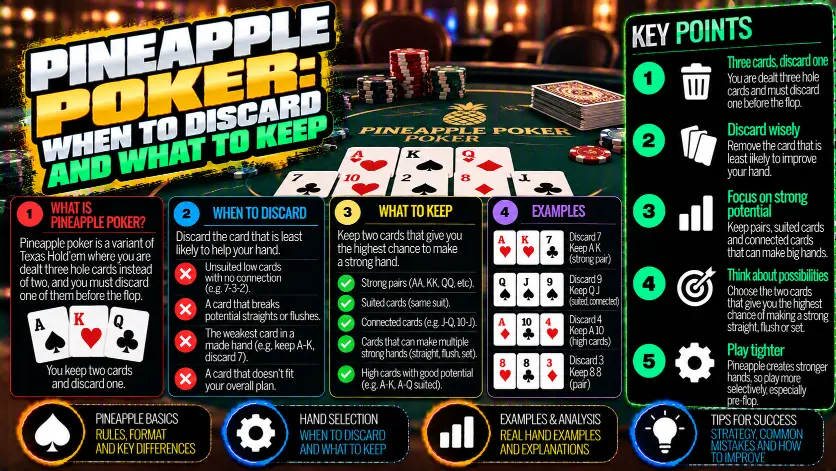
Pineapple poker starts with three hole cards, but standard Pineapple and Crazy Pineapple require you to discard one and continue with two. Lazy Pineapple is the exception: all three remain available until showdown, when two are selected rather than all three being used together.
Texas Hold'em provides the basic framework. Hole cards are hidden from opponents, while community cards arrive on the flop, turn and river. The new decision concerns which hole card to remove, not the community cards.
A discard is not an exchange. No replacement card arrives after you remove a card, so the choice reduces the hole cards available for the rest of the hand. Assessing the starting cards therefore means comparing the combinations you can retain, rather than treating every possibility offered by all three cards as permanently available.
A beginner can separate the decision to continue playing from the decision about which card to discard. An attractive three-card holding does not remove the need to choose, and a sensible discard does not automatically justify calling an opponent's bet.
The three variants and their discard timing
Standard Pineapple requires a discard before the community cards, Crazy Pineapple requires a discard after the flop betting round, and Lazy Pineapple has no discard. DeucesCracked's Pineapple guide (October 2026) describes the discard timing for the standard and Crazy variants.
Summary of variant rules; checked against sources on 29 Oct 2026
| Variant | Discard moment | Cards in hand at showdown |
|---|---|---|
| Standard Pineapple | Before any community cards are dealt | Two hole cards |
| Crazy Pineapple | After the flop betting round, before the turn | Two hole cards |
| Lazy Pineapple | No discard | Three hole cards; two are selected |
Standard Pineapple makes you choose without seeing any community cards. Your own cards are available for comparison, but the flop cannot yet show which possibilities it supports. Waiting to see the flop before choosing is not part of this variant.
Crazy Pineapple lets you see the flop and complete that betting round before discarding. The turn follows the discard, with the river later in the hand. “After the flop betting round” and “before the turn” describe the same discard moment, not alternative timings.
Lazy Pineapple keeps the choice open longer. Pokerology describes this variant as having no discard, with two of the three hole cards selected at showdown. The extra card provides another option; it does not allow all three hole cards to be used together.
Diagram: when a card is discarded in standard, Crazy and Lazy pineapple poker
Teaching diagram. Discard timing by variant; check the house rules of your table.
How pineapple poker differs from hold'em
Pineapple poker differs from hold'em through the extra starting hole card and, in most variants, the decision about which card to discard. In Standard Pineapple and Crazy Pineapple, you keep two hole cards after the discard, so you cannot assess your hand as if the third card were still available. Lazy Pineapple has no discard; you retain all three hole cards and select two at showdown.
The third hole card increases the frequency of starting holdings containing a pocket pair. That extra opportunity does not establish that every pair should be retained or played aggressively. Receiving a pair more often and making a sound decision with that pair are separate matters.
Discard timing changes the information available for the choice. Before the flop, the comparison concerns your hole cards alone. After the flop, the comparison can include how each possible retained combination connects with the community cards. The same starting cards can therefore require different reasoning in standard Pineapple and Crazy Pineapple.
Hold'em preflop hand ranges provide a baseline for comparing decisions before the flop. Applying those ranges directly to three hole cards misses the additional selection decision in pineapple poker: choosing which two cards will remain available.
Our calculation: pocket-pair frequency with two and three cards
A pocket pair appears in 17.18% of three-card deals versus 5.88% of two-card deals, making the three-card frequency 2.92 times the two-card frequency. This unconditional calculation describes the cards dealt before any action; opponents' cards and the board are not counted. Here a pair means at least two cards of one rank, so the 17.18% includes 52 of the 22,100 deals with three of a kind.
| Hole cards | Combinations containing a pair | Total combinations | Frequency |
|---|---|---|---|
| Two cards | 78 | 1,326 | 5.88% |
| Three cards | 3,796 | 22,100 | 17.18% |
Both rows answer one question: does the starting holding contain a pair? These counts concern the initial deal, not the chance of winning after the river or the quality of a later discard.
The calculation uses percentages and a ratio rounded to two decimal places. The different totals reflect holdings of different sizes, so the comparison uses their frequencies rather than their raw counts. Betting decisions, subsequent community cards and the player's choice of discard are outside this calculation.
A separate check with one known card removed from the deck leaves the reported frequencies unchanged at 5.88% and 17.18%. This result applies to that specific assumption; it does not establish that every kind of additional card information leaves the figures unchanged.
Under these assumptions, three hole cards produce a pair noticeably more often than two. Pineapple poker strategy nevertheless involves more than pairs: the frequency describes an initial opportunity, not an instruction to preserve every pair or continue every hand.
How to choose a card to discard
A discard should be assessed by comparing the two cards that would remain, using only the information available at that moment. Card rank alone is not enough to compare the retained combinations.
In standard Pineapple, mentally remove each hole card in turn. Examine whether each remaining combination contains a pocket pair, shares a suit or offers connected ranks. This comparison helps separate the actual alternatives instead of crediting one retained holding with possibilities that require the discarded card.
In Crazy Pineapple, repeat that comparison with the flop included. For example, one hole card may support a flush draw while another supports a straight draw. Discarding one of those cards means the corresponding possibility cannot simply remain in your assessment as though the card were still available.
The remaining draws need a fresh count after the discard. An outs calculator can help with that check, but a card that improves your holding is not necessarily a winning out. An improvement that still leaves an opponent ahead should not be treated as a reliable winning out.
The rule of 2 and 4 offers a quick approximation for turning outs into a chance of improvement on the relevant street. The approximation must concern the possibilities that remain after the discard, rather than opportunities attached to the original three cards.
A call with a draw requires a separate comparison between the price of continuing and the chance of improvement. The pot odds calculator supports that comparison. Choosing a suitable discard does not, by itself, make the next call justified.
Future bets can also affect the assessment of a call. The guide to pot odds and implied odds explains the distinction between the current price and potential additions to the pot later. Possible future bets should not be treated as money already secured.
Calculation limits and common mistakes
The main mistake is treating the higher frequency of pocket pairs as sufficient reason to continue any hand containing one. Community cards, the retained kicker and opponents' actions still matter.
Pineapple poker has no single official rulebook covering every variant, so confirm the organiser's procedure before playing, especially the discard moment. A clear understanding of the sequence prevents decisions based on the timing of a different variant.
Straight draws deserve a careful second look after a discard. Nearby ranks can appear more useful than they are when gaps between the required cards go unnoticed. Identify which remaining cards actually complete the combination rather than relying on the general appearance of connected cards.
A weak pair can also distort the comparison. Keeping the pair may mean giving up another combination, and the additional starting card does not guarantee a strong continuation. The decision concerns the consequences of retaining each possible holding, not merely whether one option already has a familiar combination name.
By the ToolsGambling calculation, under these assumptions, three hole cards produce a pocket pair noticeably more often than two. The practical conclusion is limited: the starting deal offers more possibilities, but discard decisions still require a separate assessment rather than an automatic preference for any pair.
Frequently Asked Questions
In standard Pineapple you discard before the community cards, so you decide without seeing the flop. In Crazy Pineapple you see the flop and finish its betting first, then discard.
An equity calculator designed for Texas Hold'em hands does not reproduce the choice among three hole cards. Its result should not be presented as a complete pineapple poker calculation.
No. At showdown in Lazy Pineapple you select two of the three hole cards, so the third card is not part of the final hand.
A simple exercise is to deal yourself three hole cards and record which two you would retain. Reveal the flop afterward and assess separately whether a later discard would have changed your choice.
A useful review compares the information available at the decision point with the reasons for the choice. A favourable river alone does not prove that the earlier decision was justified.
Evgeniy Volkov
Verified ExpertFullstack developer with a background in mathematics. I build the calculators and game-style tools on ToolsGambling with Pixi.js and modern web tech, and every result uses transparent probability formulas you can verify yourself.