













Contents
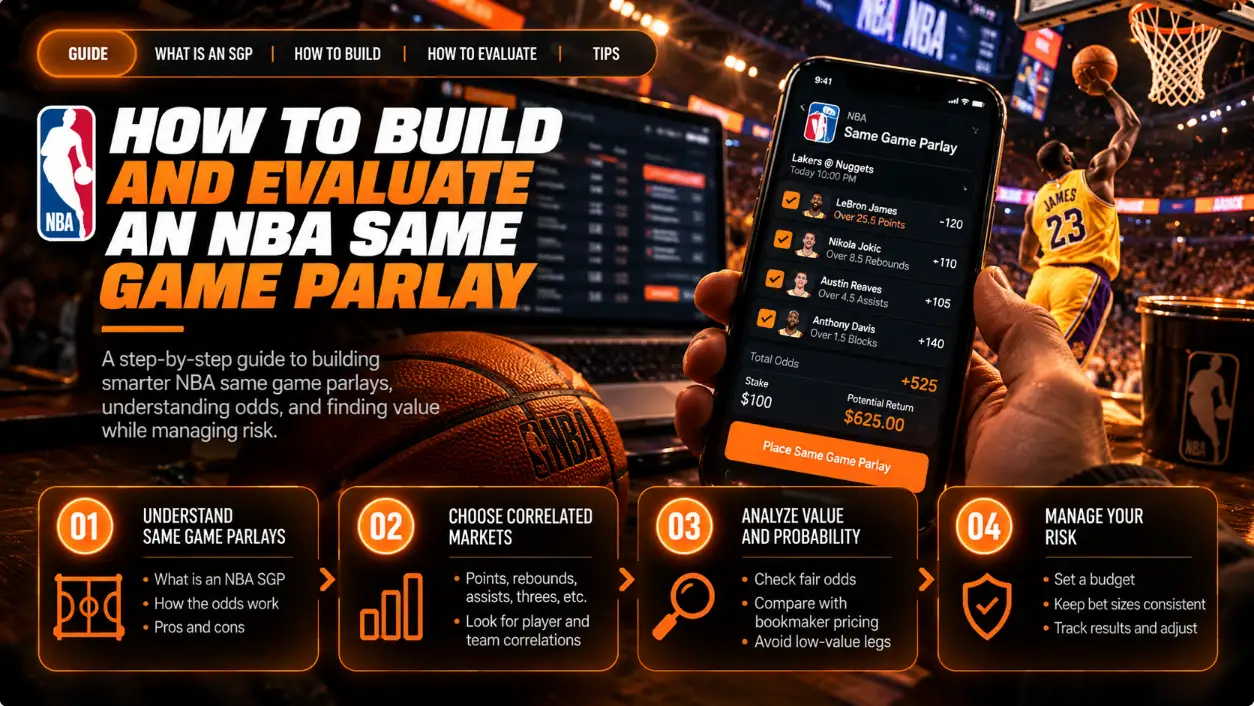
An NBA same game parlay (SGP) is one wager combining multiple selections from a single basketball game. Ordinarily, every active leg must win; voids, pushes and promotion terms can change settlement. Evaluate the quoted combined SGP odds, the joint success probability and the operator’s rules, not just whether the selections tell a plausible story.
A builder may let you combine compatible outcomes such as a team win and a player’s points total. “Bet Builder” is a provider’s product or interface label, and available combinations vary. Betting availability and legal requirements depend on your actual location.
There is no universally winning ticket. This guide explains how to evaluate a quote using hypothetical examples—not current picks or a promise of profit.
How an NBA SGP gets its price
A sportsbook quotes a separate combined price for a same game parlay; you cannot automatically obtain it by multiplying the individual leg prices. Outcomes within one game can be dependent, and the combined price reflects the particular combination.
DraftKings’ SGP help says at least two selections are needed to receive a combined quote. It also explains the all-active-selections win condition and settlement limitations for applicable states. These are DraftKings product rules, not universal sportsbook rules.
DraftKings public help excerpt explaining two selections and combined same game parlay odds
DraftKings public English-language help, checked October 12, 2026. This illustrates the product rules; it is not a live ticket or evidence of a test wager.
bet365’s Pennsylvania Bet Builder rules likewise explain that pricing accounts for effects between markets. Those rules apply to that regional product.
The practical approach is to get the sportsbook’s combined quote first, then calculate the payout from it. Multiplying individual prices is only an independence pricing benchmark, not a substitute for the SGP quote.
Which NBA markets can you combine?
You can combine only the markets and selections supported by the particular builder. Check each leg’s exact threshold and time scope: the same statistic can have different settlement conditions across markets.
| Market | Winning condition | What to check |
|---|---|---|
| Moneyline | The selected team wins | Whether overtime counts |
| Spread | The team’s result covers the stated handicap | Sign, spread size and a possible push on an integer line |
| Game total | Combined points fall over or under the threshold | Full game, half or quarter; overtime inclusion |
| Team total | One team’s points fall over or under the threshold | Team, threshold and period |
| Player points | The player meets the points condition | Threshold, participation requirements and time scope |
| Player rebounds | The player meets the rebounds condition | Threshold, participation requirements and time scope |
| Player assists | The player meets the assists condition | Threshold, participation requirements and time scope |
| Three-pointers made | The player makes the required number of threes | Made shots count, not attempts; participation and period |
| Points + rebounds + assists (PRA) | The combined statistic meets one threshold | This is one leg, not three separate legs |
25+ points means at least 25. Over 25.5 requires at least 26, while over 24.5 requires at least 25. A PRA over 32.5 selection requires a combined total of at least 33.
These examples use integer-valued basketball statistics. Check pushes on integer lines and player nonparticipation separately rather than inferring those rules from the threshold.
How to evaluate NBA parlay correlation
Evaluate the game scenario, but do not treat positive dependence between bet outcomes as proof of value. Its direction and strength depend on the thresholds, player roles and how the game develops.
Correlation describes a statistical relationship. A useful practical question is: does the second leg become more likely when the first leg wins?
| Combination | Why the outcomes may be related | What can break the scenario |
|---|---|---|
| Leading scorer’s points over + team total over | A productive scoring game can contribute to the team total | Teammates score less; minutes restrictions, foul trouble or rest |
| Passer’s assists over + teammate’s points over | The teammate’s baskets following those passes can help both statistics | The teammate scores unassisted or from other players’ passes |
| Player rebounds over + game total under | Missed shots can create rebound opportunities | Slow pace reduces shot volume; teammates collect the rebounds |
| Favorite moneyline + game total under | Strong defense can help a team win a lower-scoring game | Accurate shooting, fast pace or a productive opponent |
| Player points over + three-pointers made over | Made threes contribute to the player’s points | Scoring comes from twos and free throws; three-point accuracy falls |
These are scenarios, not recommended combinations. A blowout may help a team win while reducing a starter’s minutes. Foul trouble, rest and rotation changes can also disrupt an expected relationship. There is no universal favorite-plus-under rule.
Check logical compatibility too. Both teams scoring 110+ and the game total finishing under 219.5 is impossible over the same time scope: the combined score must be at least 220. But under 225 is not impossible with those team conditions; combined scores from 220 through 224 satisfy them.
How dependence changes probability without guaranteeing value
Joint success probability requires conditional probability, not automatic multiplication of separate chances. Positive dependence can increase the chance of both legs winning while the offered price still produces negative expected value.
For two legs:
P(A and B) = P(A) × P(B given A)
Suppose a hypothetical model assigns A a 60% chance, B a 50% chance, and B a 65% chance conditional on A winning.
| Calculation | Result |
|---|---|
| Independence assumption: 60% × 50% | 30% |
| Given conditional probability: 60% × 65% | 39% |
| Model fair decimal odds: 1 / 0.39 | 2.5641 |
| Offered combined decimal odds | 2.40 |
Positive dependence raises joint success probability from 30% to 39%. However, the offered 2.40 is below the model’s fair price of 2.5641, rounded to four decimal places.
Expected value (EV) is the average monetary result under the assumed model, not a prediction for one ticket. In a binary cash model with either a full win or a full loss:
EV = S × (p × D − 1)
Here, S is the stake, p is the estimated joint success probability of the entire ticket, and D is its decimal price. With a $20 stake:
EV = 20 × (0.39 × 2.40 − 1) = −1.28
The expected result is −$1.28, despite positive dependence. These probabilities are supplied assumptions, not measurements of a real game. The model excludes voids, partial settlement, taxes and promotion limits.
For three legs, the corresponding calculation is P(A) × P(B given A) × P(C given A and B). Calling a relationship “strong” does not supply those conditional probabilities.
How to compare combined odds with individual prices
Multiplying individual decimal prices provides an independence pricing benchmark only. The difference between that benchmark and a quoted SGP price is not automatically a measured sportsbook margin.
Suppose two selections each have American odds of −110, with the exact decimal representation 21/11. Their product is approximately 3.6446, while a hypothetical SGP quote is 3.40.
| Quantity | Value | Appropriate use |
|---|---|---|
| Each individual price | −110, or 21/11 | Price of the separate selection |
| Product of individual prices | 3.6446 | Independence pricing benchmark |
| Quoted combined SGP odds | 3.40 | Price used for the ticket’s payout |
The gap can reflect dependence and pricing adjustments. Without a separate joint-probability model, it does not establish margin, realized hold or betting value.
Use an identical-ticket comparison when comparing operators: match the game, exact selections and thresholds, time scope and overtime treatment, player participation and settlement rules, quote timing, stake limits and promotion conditions. A higher payout on a differently structured ticket is not a like-for-like comparison.
How to calculate the payout with the odds converter
Enter the already quoted combined SGP odds and your stake into the converter to calculate total payout, profit and the price-based break-even threshold. The tool does not estimate joint success probability or correlation.
To reproduce the example in the odds converter:
- Select “American.”
- Enter +240.
- Enter 20 in the stake field.
English odds converter showing +240 and a stake of 20, with decimal odds 3.40, total payout 68.00, profit 48.00 and implied probability 29.41 percent
Local ToolsGambling English-interface screenshot. The supplied inputs produce 3.40, 68.00, +48.00 and 29.41%; these are price calculations, not a game forecast.
For a $20 cash stake, the results are 3.40 decimal odds, $68 total payout and $48 profit:
Total payout = stake × decimal odds = 20 × 3.40 = 68
Profit = total payout − stake = 68 − 20 = 48
Total payout includes the winning stake returned. The price-based break-even threshold is 1 / 3.40, or 29.41%, rounded to two decimal places. In the full-win/full-loss cash model, a justified whole-ticket probability estimate must exceed that threshold for positive EV.
The implied probability derived from the price is not an established chance of winning. For more on price formats, see the guide to how betting odds work.
What to check before building the ticket
Check current player availability and roles before choosing legs. An injury-report status does not guarantee playing time or replace rotation analysis.
Start with the NBA’s official site and the latest report for the relevant game. The 2025–26 injury-report page identifies an official source, but for a real wager you must find the current season and newest report. Check its timestamp, participation status and stated reason.
Historical official NBA injury-report crop showing player names and participation statuses
Official historical NBA injury report, March 4, 2026, 07:00 AM, page 1, in English. The crop shows names and statuses, not column headings, the timestamp or reasons. It is a reading example, not current lineup information.
The full historical report provides the context. “Questionable” indicates uncertain participation; “Out” indicates the player was unavailable at that report’s timestamp. “NOT YET SUBMITTED” elsewhere in the full document means the report had not been submitted—not that everyone was healthy.
Next, review role and rotation: expected minutes, potential rest and lineup changes. Box-score minutes, shot attempts and player responsibilities are more informative than points alone. A short streak of hitting a threshold is not a probability estimate for the next game.
Then follow this sequence:
- Choose the game and its available SGP builder.
- Add compatible selections with exact thresholds.
- Check each market’s period and overtime treatment.
- Inspect the combined quote and participation, push and void rules.
- If useful, compare identical tickets at operators available to you.
- Set the amount you can afford to lose—or skip the bet.
You can learn by examining quotes without depositing or placing a wager. If you lack a justified probability estimate or cannot understand the settlement rules, skipping is a valid decision.
What happens after an injury, push or overtime?
Settlement depends on the product, market and jurisdiction. A void leg is not always simply removed from the parlay, so find the applicable rule before betting.
| Situation | What to establish |
|---|---|
| Player never takes the court | How participation is defined; whether the leg is voided, the ticket repriced or the entire wager voided |
| Player plays, then leaves injured | Whether the leg remains active and whether eligible early-exit protection applies |
| Statistic lands exactly on an integer line | How a push affects the whole SGP |
| Game goes to overtime | Whether each market includes it; distinguish full-game, half and quarter markets |
| Game is postponed | Waiting periods and conditions for voiding |
| Statistics are corrected | The official settlement source and any correction or resettlement window |
| Cashout is offered | Whether this ticket is eligible and what the actual offer requires |
DraftKings’ void rules depend on the applicable state. Its Early Exit protection program can void an eligible NBA selection and recalculate an SGP after a first-half injury when the player does not return. Eligibility, market and regional requirements still apply; the page excludes period-specific markets. Not every injury results in a refund.
bet365’s Pennsylvania rules provide recalculation for certain void-player cases in the listed sports. Other voids or pushes can void the entire wager. Do not extend those exceptions to another region or assume they cover every basketball market.
There is no universal overtime policy safe to apply across all markets. Likewise, do not assume cashout will normally be available: inspect an actual offer, but do not base risk management on one appearing later.
How a profit boost changes payout and EV
A profit boost increases winning profit under the promotion’s terms; it does not increase the ticket’s chance of winning. Evaluate the boost alongside the original price and promotion limits.
For this hypothetical uncapped example, open the profit-boost calculator:
- Select “Decimal.”
- Enter 20 under “Your stake.”
- Enter 3.40 under “Original odds (before boost).”
- Enter 25% under “Profit boost.”
- Expand “Promo limits and EV.” Leave the cap toggles off only for this uncapped example.
English profit-boost calculator showing a stake of 20, original decimal odds 3.40 and a 25 percent profit boost with a supplied 28 percent probability estimate
Local ToolsGambling interface for a hypothetical uncapped promotion. The 28% probability is supplied for demonstration, not forecast by the calculator.
| Measure | Without boost | With 25% profit boost |
|---|---|---|
| Cash stake | $20 | $20 |
| Profit if the ticket wins | $48 | $60 |
| Additional profit | — | $12 |
| Total payout including stake | $68 | $80 |
| Effective decimal odds | 3.40 | 4.00 |
| Break-even threshold | 29.41% | 25% |
The additional profit is 48 × 25% = 12, making winning profit $60 and total payout $80. The ticket’s probability is unchanged. The unboosted threshold is rounded to two decimal places.
To reproduce the conditional EV calculation, select “I have a true win estimate (for EV)” and enter 28. Despite the interface label, 28% here is only a synthetic assumption:
- At 28%, EV before the boost is −$0.96.
- After the boost, EV is +$2.40.
- At 24%, boosted EV is still −$0.80.
These results use the same binary cash model: full win or full loss, with no voids, taxes or caps. In real use, leave the estimate empty unless you have a justified whole-ticket probability. The calculator cannot discover that probability.
Check maximum extra profit or payout, eligible stake size and markets, minimum odds, minimum legs, expiry and void treatment. If a bonus stake is not returned in the payout, the cash model above does not apply.
How many legs should you choose?
Adding a condition cannot increase the probability that every leg wins. However, fewer legs or a lower alternate threshold do not automatically offer value.
For illustration only, suppose every leg has a 60% chance and all legs are independent:
| Number of legs | Joint success probability |
|---|---|
| 2 | 36% |
| 3 | 21.6% |
| 5 | 7.776% |
These numbers do not describe real dependent NBA markets. They show how extra conditions can accumulate. More generally, “all existing legs win and one additional leg wins” is a subset of “all existing legs win,” so its probability cannot be higher.
Two legs do not automatically make an SGP valuable, and lowering a threshold generally changes the price. Compare probability with price, not just how comfortable a condition feels. A single bet is a reasonable alternative when the additional leg lacks a convincing basis.
Leg count alone does not establish a universal house edge, and no bankroll percentage is safe for every reader. Track overlapping exposure: several tickets involving the same player can lose together because of nonparticipation, restricted minutes or poor performance. Record those overlaps, set spending limits in advance and do not increase stakes to chase losses. The bankroll management guide covers the broader budgeting approach.
How to make the final decision
Consider betting only when you understand every leg, the combined quote, settlement rules and the amount you could lose. If your aim is positive expected value, you also need a justified joint success probability—not merely a coherent game narrative.
Before confirming, check that player information is current, ticket conditions are compatible, injury and push consequences are clear, and payout uses the actual quoted combined SGP odds. Evaluate any profit boost separately under its limits.
Calculators check arithmetic. They do not replace game analysis, establish an edge over the sportsbook or turn a plausible scenario into a guaranteed win.
Frequently Asked Questions
Only if your sportsbook offers that separate product. A standard same game parlay contains selections from one game. Combining multiple same game parlays across games has its own availability, restrictions and settlement rules.
That depends on the sportsbook, product and your location. Where live same game parlays are available, prices and compatible selections can change during the game. Check the latest quote, each market's time scope and the settlement rules before confirming.
The selections may be incompatible, or the product may restrict that combination. For example, both teams scoring 110+ cannot coexist with a game total under 219.5 over the same period. However, a blocked combination is not necessarily mathematically impossible; check the market descriptions and operator rules.
No. This is an evergreen guide to evaluating a ticket, not a list of current picks. All numerical examples are hypothetical, and the injury report shown is a historical document rather than today's lineup information.
Evgeniy Volkov
Verified ExpertFullstack developer with a background in mathematics. I build the calculators and game-style tools on ToolsGambling with Pixi.js and modern web tech, and every result uses transparent probability formulas you can verify yourself.