












Contents
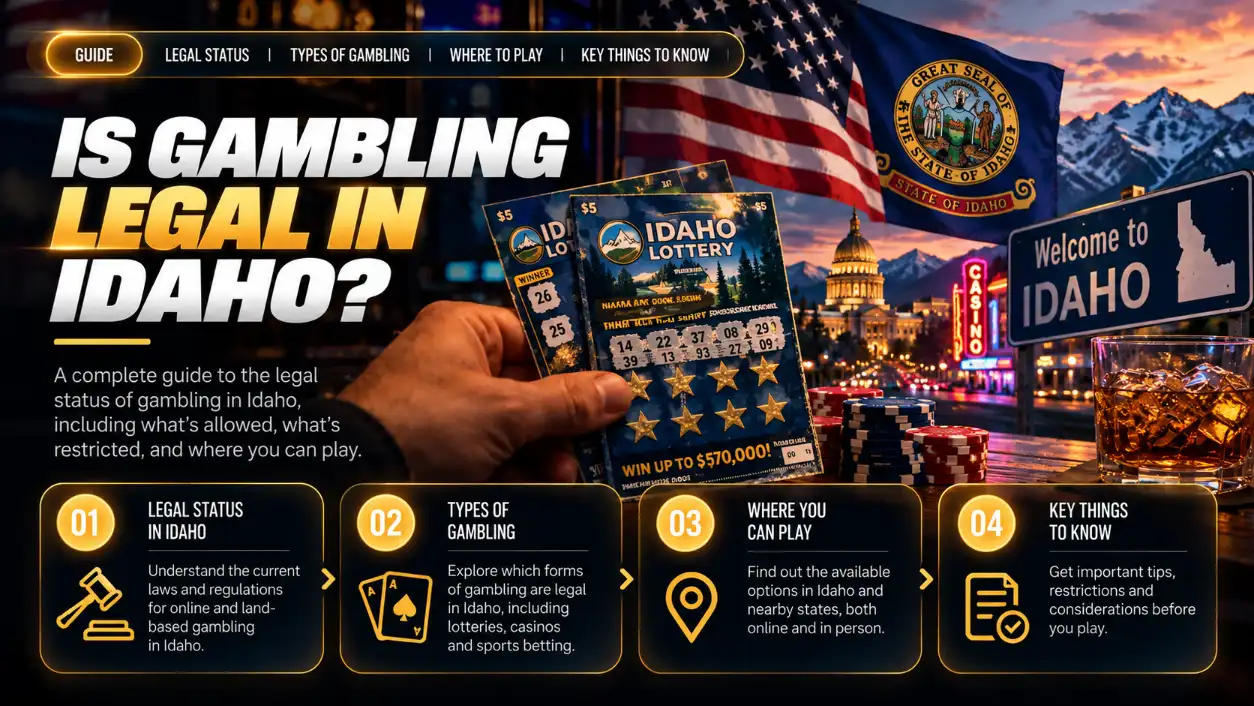
Yes, but only within limited exceptions and the applicable tribal gaming framework. Idaho has a state lottery, regulated horse-racing wagering, qualifying charitable bingo and raffles, and gaming on tribal lands under separate rules. As of the review on October 12, 2026, Idaho has no state-licensed sports wagering, online casino or online poker market.
An accessible app, a nonprofit organizer, a tribal casino address or an offer of free coins does not automatically make gambling legal. Check the specific product, the organizer’s authority and your eligibility, rather than relying on a brand name.
This guide provides general information, not individualized legal advice. The law, an operator’s policies and actual service availability are separate questions.
Which Gambling Products Are Authorized?
Idaho authorizes specific categories, not gambling generally. Use this comparison to identify the relevant source, then check the conditions for that product.
| Product | Idaho status | Where to verify |
|---|---|---|
| State lottery | Authorized; official ticket sales are through retailers | Idaho Lottery |
| Tribal casino gaming | Permitted within the applicable federal and tribal framework, including tribal-state compacts where required | Venue website; Indian Gaming Regulatory Act |
| Horse-racing wagering | Authorized within the regulated system | Idaho State Racing Commission |
| Charitable bingo and raffles | Authorized for qualifying organizations that meet the requirements | Charitable gaming FAQ |
| Sports wagering | No Idaho-licensed market | State law, not an app directory |
| Online casino and online poker | No Idaho-licensed market | State law |
| Paid fantasy contests | Not authorized merely because they differ from sportsbook betting | Historical attorney general materials and current product rules |
| Event contracts | Subject to a separate state–federal jurisdiction dispute | Legal proceedings and current platform terms |
| Sweepstakes casinos and home poker | No automatic exemption | State law and the actual game conditions |
Check age separately. The Idaho Lottery and Coeur d’Alene Casino confirm 18+ requirements. Horse-racing wagering is also restricted to people 18 and older: “Wager — Person Under Eighteen” in the current Idaho Racing Commission rules, IDAPA 11.04.01, prohibits wagering by anyone under 18. Do not apply that age to every venue or product; operators may impose stricter eligibility requirements. Reaching adulthood does not make prohibited sports betting or casino gambling lawful.
What Does Idaho Law Prohibit, and What Are the Exceptions?
Idaho’s constitution prohibits gambling but provides narrow exceptions for the state lottery, pari-mutuel wagering, charitable bingo and raffles. Those exceptions do not broadly authorize casino games offered under those labels.
The constitution also contains limited exclusions for certain merchant promotions without payment to participate and certain extra-play arrangements. Their conditions matter: calling an offer “free” does not establish that its mechanics qualify. See Article III, Section 20 of the Idaho Constitution.
The statutory definition covers risking money or property for a return dependent on chance or the outcome of an event, and expressly includes sports events and poker. Participating in prohibited gambling, or allowing property under your control to be used for it, can be a misdemeanor. See the gambling definition and the offense provision in the 2025 statutory mirror.
Unless a specific provision sets a different penalty, the general misdemeanor maximum is six months in jail, a $1,000 fine, or both. That is the limit in the general penalty statute, not a prediction about any individual case.
What Is Allowed at Tribal Casinos?
Only gaming that meets the applicable legal framework is authorized at a tribal casino. A location on tribal land does not authorize every gambling product.
The Indian Gaming Regulatory Act distinguishes gaming classes. Class II includes certain bingo and related games but excludes banking table games—games played against the house. Class III gaming requires a tribal-state compact and other conditions. It is therefore incorrect to classify every Idaho gaming machine as Class II or treat all tribal gaming as exempt from restrictions. See the federal framework.
Idaho also has a specific statutory mechanism for tribal video gaming, associated with the 2002 initiative and §§ 67-429B/C. The official historical initiative text explains its origins; it does not replace a check of current venue rules.
Examples to verify include:
- Coeur d’Alene Casino: its official website states 18+.
- Shoshone-Bannock Gaming: lists Fort Hall, Bannock Peak and Sage Hill.
- Clearwater River Casino: a venue in Lewiston.
These are examples, not a complete list. This guide does not confirm live poker, particular table games or age requirements at the latter two operators. Check the selected venue’s current rules.
Can You Bet on Sports or Enter Paid Fantasy Contests?
Idaho has no state-licensed sports wagering market, and a paid fantasy contest is not authorized simply because of its product name or brand.
In 2016, Idaho’s attorney general reached agreements with DraftKings and FanDuel to stop offering paid fantasy contests in the state. These were historical legal interpretations and agreements, not a new 2026 law. See the 2016 annual report, PDF pages 15–16, printed pages 14–15.
Excerpt from the Idaho attorney general’s 2016 report discussing paid fantasy contests
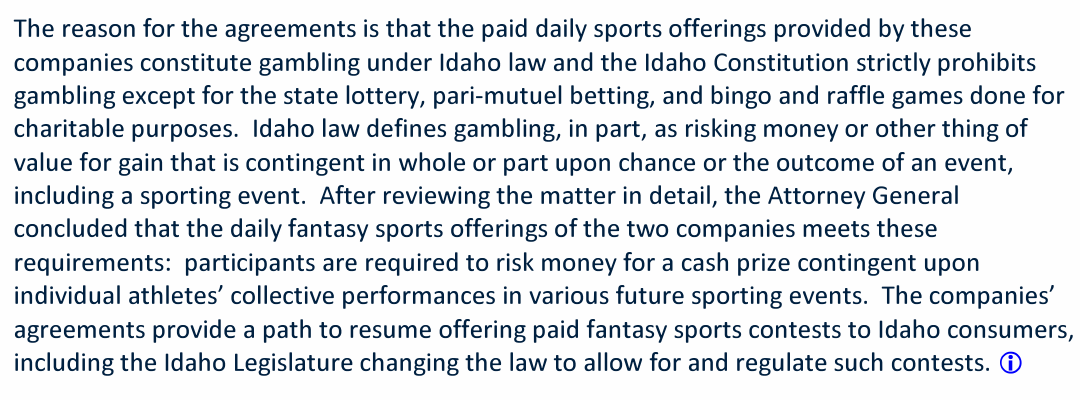
Original English-language report from 2016. It documents historical agreements, not a current license.
Check each brand’s products separately:
| Brand and product | What is verified | What it does not establish |
|---|---|---|
| DraftKings paid fantasy contests | Current eligibility rules exclude Idaho | Eligibility for other DraftKings products |
| FanDuel paid fantasy contests | Participation in the 2016 agreements | Current availability of every FanDuel product |
| DraftKings Racing | Appears on the Racing Commission’s operator list | Authorization for general sports wagering |
| TwinSpires horse-racing wagering | Appears on the Racing Commission’s operator list | Authorization for casino games or other sports wagering |
Are Event Contracts a Legal Workaround?
No prediction market should be treated as a universally lawful workaround for sports wagering restrictions.
On March 23, 2026, Idaho’s attorney general described a coalition position supporting states’ authority to regulate sports wagering, including the dispute over event contracts. This is a party’s position in a legal dispute, not a final court ruling.
Availability on a platform such as Kalshi is not an Idaho sports wagering license. This guide also does not establish the exhaustive, current status of every related court proceeding when you intend to participate.
How Do You Verify Legal Horse-Racing Wagering?
Start with the Idaho State Racing Commission’s current operator list, then check the selected service’s eligibility rules.
This category involves betting into a shared pool from which winning payouts are distributed—pari-mutuel wagering. It is distinct from general sportsbook betting.
The Racing Commission publishes information about live racing, simulcast wagering and advance-deposit wagering operators, which accept wagers through funded accounts.
Idaho State Racing Commission list of advance-deposit wagering operators
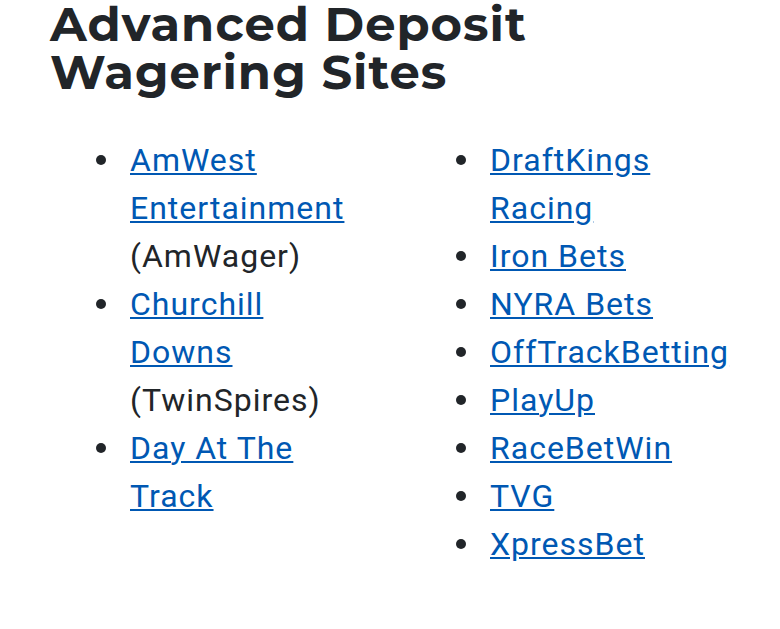
Original English-language list reviewed on October 12, 2026. Check the current version before using a service.
Use this repeatable check:
- Open the commission’s official website.
- Locate its operator list and match the service’s exact name.
- Read that operator’s rules for Idaho eligibility, age and physical location.
- For a particular race, separately check the schedule and whether wagering is offered.
A published schedule does not guarantee that a race will take place or be available for wagering.
Can You Buy Idaho Lottery Tickets Online?
The Idaho Lottery does not sell tickets directly over the internet or by mail, but that does not establish that every courier order is unavailable.
The lottery’s official FAQ describes retail sales and an 18+ requirement. Separately, Jackpocket lists Idaho as a supported state and requires physical presence in a supported state.
The distinction is how the ticket is obtained: a courier purchases a physical retail ticket on your behalf rather than turning the lottery’s website into a direct online sales channel. Jackpocket states an 18+ requirement and says it is not affiliated with the state lottery.
A courier’s availability statement is an operator statement, not confirmation of regulatory approval. Check its current terms alongside lottery information before ordering. Do not assume historical fees or prize limits still apply.
When Does Charitable Gaming Require a License?
Idaho Lottery guidance requires a license above specified thresholds, but other legal requirements still apply below them.
Eligibility covers qualifying tax-exempt organizations, not only one tax-exempt category. Nonprofit status alone does not authorize an organization to conduct gambling.
The official charitable gaming FAQ identifies these thresholds:
- Bingo: more than $10,000 in annual gross revenue.
- Raffles: more than $5,000 in aggregate merchandise prize value.
The current official IDAPA 52.01.03 compilation uses different wording: Section 505.01 describes the bingo licensing exemption as annual gross sales of less than $10,000, while Section 310.01, addressing hard-card bingo, says $10,000 or less. Before organizing bingo with exactly $10,000 in annual gross sales, check the current statute and confirm the requirements with the Idaho Lottery. For raffles, Section 505.02 provides an exemption when aggregate merchandise prize value does not exceed $5,000; Section 505.03 preserves other requirements.
Idaho Lottery information about charitable gaming licensing requirements
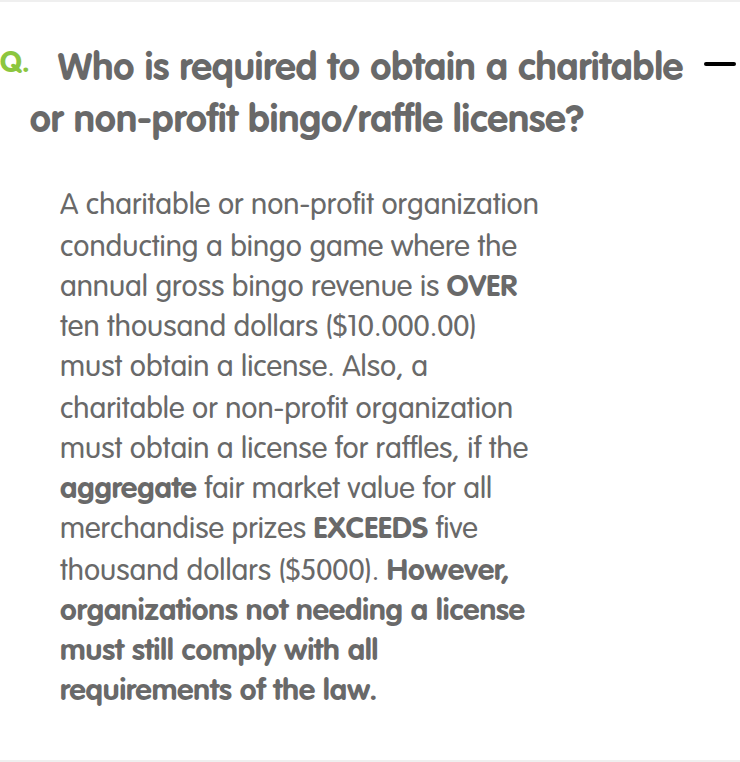
Original English-language licensing guidance. Staying below a licensing threshold does not remove other legal requirements.
Examples on either side of the thresholds:
| Example amount | Does it exceed the FAQ threshold? |
|---|---|
| Annual bingo gross revenue: $9,999 | No |
| Annual bingo gross revenue: $10,001 | Yes |
| Aggregate raffle merchandise prize value: $4,999 | No |
| Aggregate raffle merchandise prize value: $5,001 | Yes |
These examples assume exact amounts, with no rounding. For bingo, the measure is annual gross revenue, not net profit. For raffles, it is aggregate merchandise prize value, not ticket revenue. The comparison tests only whether the threshold is exceeded, not every condition for lawful gaming.
Before participating, identify the organizer, check whether it qualifies and determine whether a license is required. If one is required, verify its details through the Idaho Lottery. A charitable purpose does not itself authorize a gambling “casino night.” The Idaho Lottery’s guidance on entertainment games calls for removing either consideration (payment to participate) or prizes.
Are Sweepstakes Casinos and Home Poker Legal?
Neither a sweepstakes casino nor a home game receives an automatic exemption from Idaho’s gambling prohibition.
For a sweepstakes casino, examine what participants purchase, how entry is provided and whether money or property can be won. Free coins or a separate no-purchase entry method do not by themselves establish compliance with the narrow exclusions in the Idaho Constitution.
The cited statutes provide no general “friends-only” exception for home poker. Poker is expressly included in the gambling definition. Playing for money does not become authorized merely because the game is at home or the organizer takes no fee. Assumptions about infrequent enforcement do not establish legality either.
What Should You Check Before Playing?
Verify the product category, relevant authority, organizer and your eligibility before participating. You do not need to make a deposit to perform these checks.
- Identify the exact product. Casino games, lottery tickets, horse-racing wagering, fantasy contests and event contracts require different checks.
- Use the right source. Consult the Racing Commission for horse racing, the Idaho Lottery for lottery and charitable gaming, and the applicable federal framework and venue information for tribal casinos.
- Verify the organizer. A familiar brand does not establish authorization for every product it offers.
- Check age requirements. Do not assume a single minimum applies across categories.
- Separate residence from physical location. A service may require you to be physically present in an eligible jurisdiction.
- Check the date. A source reviewed on October 12, 2026 does not guarantee that a license or rule remains unchanged later.
- Treat uncertainty as uncertainty. If authorization is unclear, ask the relevant authority or obtain legal advice rather than treating access as proof.
If you travel to a bordering state, check that state’s current rules and the specific product’s requirements. Where physical presence is required, living near the border or having an address in another state is not enough. Access in another state does not make the same product authorized from Idaho.
What About Taxes and Responsible Gambling?
Winnings can create tax obligations, and authorized gambling still carries a risk of loss.
The IRS explains taxable gambling winnings and recordkeeping. Idaho also has an individual income tax. Withholding is a tax prepayment, not the final calculation of what you owe. Do not treat a rate published for a different tax year as a universal current rate.
Set affordable spending and time limits before playing. If control becomes difficult, check the specific operator’s available restrictions and self-exclusion options; these may cover only certain products or venues.
The National Council on Problem Gambling’s help page provides current ways to seek support. You can also use the nine-question self-check. It screens for possible gambling-related problems; it is not a diagnosis, a legality check or a financial tool.
Frequently Asked Questions
No. Residence, physical location, age and product eligibility are separate requirements. Check each one for the specific service you want to use.
No. An overseas license does not by itself establish that a product is authorized in Idaho or that the operator may accept players located there.
No. A document's date shows when it was published or reviewed. Check the regulator's current list and the operator's current eligibility rules before participating.
No. Check the regulator's information, product rules, age requirements and location restrictions first. Making a deposit proves nothing about legal authorization.
Evgeniy Volkov
Verified ExpertFullstack developer with a background in mathematics. I build the calculators and game-style tools on ToolsGambling with Pixi.js and modern web tech, and every result uses transparent probability formulas you can verify yourself.