













Contents
There is no universally best MLB same game parlay. Assess the exact eligible selections, baseball context and settlement rules, then compare the quoted combined price with an independently estimated probability that the whole ticket wins. If that probability or the rules are unclear, passing is a reasonable decision—not a missed guaranteed opportunity.
This guide uses hypothetical tickets and explicit probability assumptions, not today's picks, current player statistics or a tested profitable strategy. Operator examples illustrate public rules; they do not establish availability in your location.
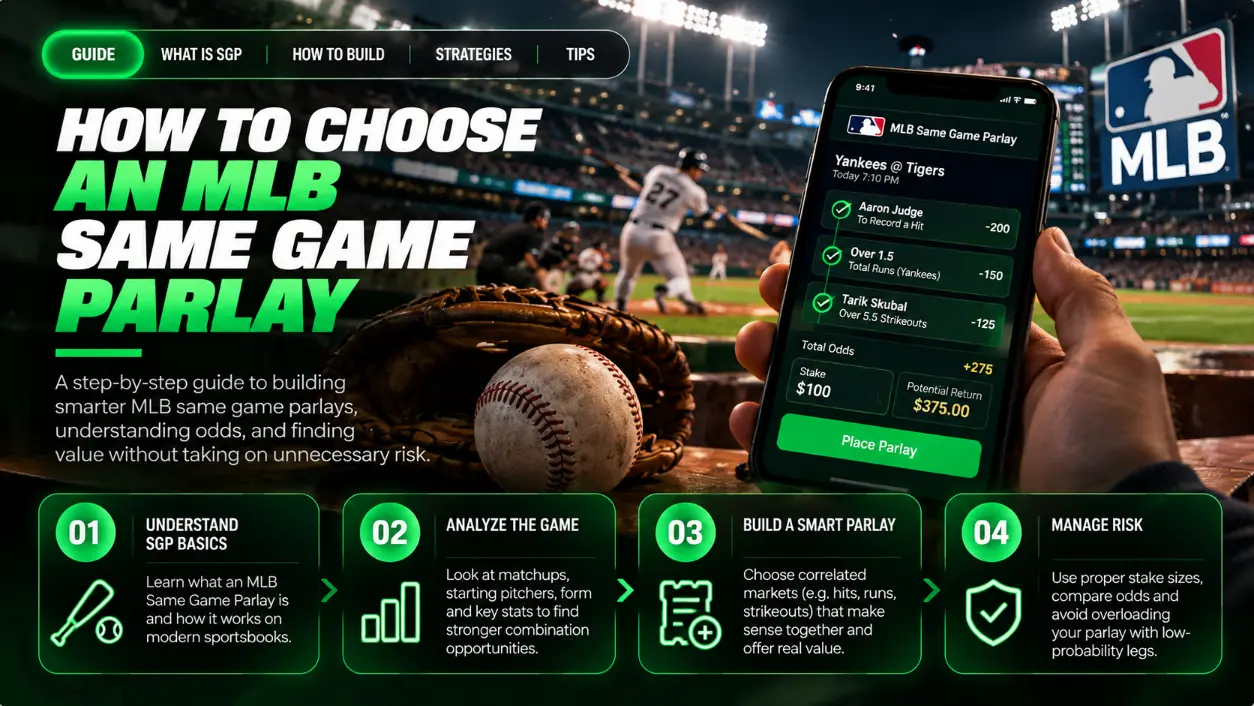
What is an MLB same game parlay, and how do you build one?
A same game parlay, or SGP, combines selections from one MLB game into a single ticket. All active legs must win, subject to the operator's void and push rules. A multiple-game parlay combines selections from different games; products called SGP+ or SGPx can combine same-game groups from different events.
Use the following sequence rather than assuming that every market on a game can be combined:
- Find an eligible MLB event displaying the operator's SGP label.
- Choose two exact selections, including the player or team, threshold and betting period.
- Obtain the combined quote. DraftKings public help states that at least two selections are needed before a quote appears.
- Check the applicable settlement rules, stake limits and any promotion terms before staking.
DraftKings public help explaining the two-selection requirement for a same game parlay quote
DraftKings public help, captured October 12, 2026, explains the two-selection requirement. A combined quote is a price, not an independently estimated chance of winning.
SGP pricing can reflect how selections interact, so the combined quote need not equal the product of their individual prices. These instructions rely on DraftKings public help, not live account testing. For a broader introduction, see the same game parlay guide.
What do the main MLB markets actually require?
Each market measures a specific result; team scoring, hitter production and pitcher strikeouts are not interchangeable. Confirm both the threshold and period before combining them.
| Market or hypothetical selection | What must happen | Important distinction |
|---|---|---|
| Team moneyline | The selected team wins | A team result, not an individual pitcher's official win |
| Team run line −1.5 | The selected team wins by two or more runs | A one-run win does not cover |
| Full-game total over 8.5 | The teams score at least nine combined runs | Both teams contribute to the total |
| Team total over 4.5 | The selected team scores at least five runs | The opponent's runs do not count toward this selection |
| Pitcher strikeouts over 6.5 | The named pitcher records at least seven credited strikeouts | Check starting and participation conditions |
| Hitter hits over 0.5 | The named hitter records at least one hit | A walk is not a hit |
| Hitter total bases over 1.5 | The hitter records at least two total bases | One double or two singles can satisfy it; walks do not count |
| Hitter home run | The hitter records a home run | A home run contributes four total bases |
| First-five innings market | The specified result is assessed over the first five innings | It is not a full-game result |
| Full-game market | The specified result is assessed over the applicable full-game period | Check extra-innings and shortened-game rules |
MLB defines total bases as bases gained through hits. A single contributes one, a double two, a triple three and a home run four.
A strikeout is credited when a batter receives three strikes, even if the batter reaches first safely on an uncaught third strike; it does not always mean an out was recorded. A plate appearance is a completed turn batting; it is broader than an at-bat.
Hits, runs, runs batted in and total bases measure different things. A hitter can walk and later score without recording a hit or total base. These statistical definitions explain the outcomes, but the operator's rules determine how a betting market settles.
Which hypothetical combinations have a coherent baseball rationale?
A coherent combination needs a plausible route to every leg winning and a clear account of how that route can fail. A convincing baseball story is not, by itself, evidence that the quoted price offers value.
| Hypothetical combination | Conditions that could support it | How the story can fail |
|---|---|---|
| Starter records seven-plus strikeouts + team wins, or starter seven-plus strikeouts + game under 8.5 | Sufficient pitch count and expected innings, strikeout opportunities against the actual lineup, and suitable team or scoring context | Early removal can stop the strikeout leg. The starter's own offense can score too little for a win or enough to threaten the under. Either bullpen can change the result. |
| Team total over 4.5 + a hitter records two-plus total bases | Confirmed lineup position, likely plate appearances and a plausible route to both team scoring and that hitter's extra-base production | The team can score through other hitters. Walks may help the team total while contributing nothing to the hitter's total bases. |
| Opposing starter strikeouts under 6.5 + your team's total over 4.5 | Contact opportunities, walks, workload and a possible early exit, each assessed separately | Low strikeouts do not guarantee runs. An early exit may expose the offense to a strong bullpen, while walks can reduce strikeout opportunities without producing enough scoring. |
| Same hitter home run + four-plus total bases | A credited home run supplies four total bases under matching periods and participation rules | Without a home run, the home-run leg loses even if the hitter reaches four total bases another way. The book may reject this logically overlapping combination. |
The last example is especially important: a home run already implies four total bases. It is not an independent second achievement. Do not assume that the combination is accepted or that adding the total-bases leg creates extra value.
For the first three scenarios, the direction and strength of the relationship depend on the exact thresholds, player roles, periods and game context; there is no universal correlation coefficient. The final home-run/4+ total-bases scenario is a logical implication: under matching rules, a home run contributes four total bases and therefore guarantees at least four total bases.
What baseball information should you check before requesting a price?
Check confirmed pitchers and lineups, expected opportunities, both bullpens, park context and actual weather before judging a ticket. Record when you checked: a sensible assessment can become outdated after a lineup change or pitching announcement.
- Confirm the pitchers and lineups. Consult MLB probable pitchers and MLB starting lineups. Record the confirmation time and distinguish a confirmed lineup from an expected one.
- Assess the starter's opportunity. Consider workload, expected innings, pitch count and strikeout opportunity against the actual opponent lineup. An opener's likely workload is different from that of a bulk pitcher expected to follow.
- Include both bullpens and the starter's own offense. Full-game totals and team wins are not settled when the starter leaves. Relief availability and scoring by either team can break a starter-focused rationale.
- Check the hitter's role. Batting order affects plate-appearance opportunities. Review handedness and player-specific splits with sample-size limitations; do not assume a universal opposite-hand advantage.
- Read park factors in context. Identify the metric, period, handedness and roof or day/night filters. A number without those settings is incomplete information.
- Check actual weather and roof status. Consider wind direction, temperature, rain risk and whether the roof will be open or closed. Do not replace these checks with unsupported humidity claims or fixed estimates of extra ball carry.
Baseball Savant park-factor table showing Coors Field at 112 for the selected wOBA metric over 2024–2026
Baseball Savant's original English table, captured October 12, 2026: the 2026, rolling-three-year, Both, All and wOBA settings show a 2024–2026 period and Coors Field at 112.
On Baseball Savant, 100 is average for the selected park-factor metric. Different metrics can produce different readings. The displayed 112 is not a fixed multiplier for one game's scoring or one player's probability.
For a deeper modeling workflow, use the MLB betting model guide. A team-win probability alone cannot price an SGP containing pitcher strikeouts and a game total.
How should you estimate the probability that every leg wins?
Estimate joint success probability by accounting for what each earlier condition tells you about the remaining conditions. Multiplying standalone probabilities is appropriate only under an independence assumption, which you should not silently apply to related outcomes.
Conditional probability means “the chance of this outcome, given that another specified outcome has happened.” The following is a labeled hypothetical model, not MLB statistics or a validated forecast:
- A: the team wins, assumed probability 55%.
- B: the starter records at least seven strikeouts, assumed standalone probability 50%.
- B given A: assumed probability 65%.
Under those assumptions:
P(A and B) = P(A) × P(B given A)
= 0.55 × 0.65 = 35.75%.
Under independence, the result would instead be:
0.55 × 0.50 = 27.50%.
Now add C, game under 8.5, and assume P(C given A and B) = 70%:
P(A and B and C) = 0.55 × 0.65 × 0.70 = 25.025%, or 25.03% rounded.
The additional condition reduces the chance that all conditions succeed. It does not simply inherit the standalone probability of an under.
For the two-leg A-and-B ticket, suppose the offered decimal price is 2.70 and the cash stake is $20. Assuming full-win/full-loss settlement, returned cash stake on a win, and no fees, taxes or voids:
- Break-even win rate: 1 ÷ 2.70 = 37.04%.
- Expected value: 20 × (0.3575 × 2.70 − 1) = −0.695, rounded to −$0.70.
Money and displayed percentages are rounded to two decimals unless the unrounded figure is explicitly shown. Despite positive dependence in this model, 35.75% remains below the price's break-even threshold. Positive dependence does not prove value, and the actual joint success probability remains unknown without a validated model.
How do you check the final combined quote?
Enter the final SGP quote—not the individual leg prices—into the odds converter to see its return and implied probability. The converter translates a price; it does not estimate baseball probabilities or dependence.
Use this repeatable example in the odds converter:
- Select American as the input odds format.
- Enter the final combined quote +240.
- Enter a cash stake of 20.
- Read the decimal odds, total return, winning net profit and implied probability.
| Result for final quote +240 and cash stake $20 | Value |
|---|---|
| Decimal odds | 3.40 |
| Total return on a win, including stake | $68.00 |
| Winning net profit | $48.00 |
| Implied probability | 29.41% |
English odds-converter example showing final American odds +240, stake 20, decimal odds 3.40, return 68, profit 48 and implied probability 29.41%
Localized English localhost example, not a production-account test. The screenshot shows price, stake and conversion results; 29.41% comes from the price, not a forecast. It does not show the optional lower EV panel.
In the full-win/full-loss cash model, with returned stake on a win and no fees, taxes or voids, 1/D is the break-even win rate, where D is decimal odds. It is not a prediction of what will happen.
If you separately supply a hypothetical whole-ticket probability of 28%, the optional calculation gives a displayed edge of −4.80% and EV of −$0.96 on $20. The displayed edge is not a 4.80-percentage-point probability gap: the assumed probability is 28%, while the price-derived threshold is 29.41%. EV here is:
20 × (0.28 × 3.40 − 1) = −$0.96.
Two quoted −110 singles multiply to decimal 3.6446, about +264.46. That is an independence pricing benchmark, not fair SGP odds or a measurement of the operator's margin. Generic parlay builders multiply individual prices, even when they display a same-game warning; do not treat them as correlation engines.
How should you compare prices across operators?
Compare identical tickets under matching rules and quote times, then assess the price against the same independently estimated joint success probability. There is no permanent best-book ranking.
For a hypothetical ticket with 28% assumed joint success probability and a $20 cash stake:
| Quoted decimal price | Total return on a win | Break-even win rate | EV at assumed 28% |
|---|---|---|---|
| 3.40 | $68.00 | 29.41% | −$0.96 |
| 3.60 | $72.00 | 27.78% | +$0.16 |
These figures assume full-win/full-loss cash settlement, returned stake on a win and no fees, taxes or voids. The apparent positive value at 3.60 is tiny and sensitive to probability error; an estimate slightly below 28% can erase it.
Before treating two quotes as comparable, match:
- Event, player and exact thresholds.
- First-five or full-game period and extra-innings treatment.
- Starting, participation and void rules.
- Quote time and stake limits.
- Whether a promotion is included and whether the stake is cash or bonus funds.
A higher headline price is not necessarily the better comparison if its market or settlement terms differ.
What does a profit boost change?
A profit boost increases eligible winning profit, not the returned stake or the ticket's chance of winning. Its value depends on the original price, your whole-ticket probability estimate and the actual promotion terms.
Take the earlier +240, $20 cash-stake example. This is a hypothetical 25% profit boost, not a current offer:
| Calculation | Result |
|---|---|
| Original winning net profit | $48.00 |
| Extra profit: 25% of $48 | $12.00 |
| Boosted winning net profit | $60.00 |
| Total return, including $20 stake | $80.00 |
| Effective decimal odds | 4.00 |
| Break-even win rate | 25.00% |
| EV at assumed joint probability 28% | +$2.40 |
| EV at assumed joint probability 24% | −$0.80 |
The example assumes the boost applies fully without a cap, cash stake is returned on a win, and there are no fees, taxes or voids. A better price can still have negative EV when the probability is too low.
Check minimum legs and odds, maximum stake, eligible markets, and whether a cap limits extra profit or total payout. Also distinguish cash from bonus stakes: bonus stakes may not be returned. Apply the actual terms rather than reusing the cash calculation. The profit boost calculator can help with the arithmetic.
Should you use fewer legs or bet singles instead?
Fewer legs are usually easier to assess, but they are not automatically profitable. Adding another required condition cannot increase the probability that every condition wins, while leg count alone does not determine the house edge.
Singles can avoid the parlay's all-or-nothing settlement: one winning single can return money even if another loses. They do not create value, and related singles can still expose you to the same underlying game risks.
Choose the structure only after evaluating the selections and prices. Do not add a weakly understood leg merely to reach a more attractive payout or a promotion's minimum-leg requirement.
Which settlement rules can change the result?
Settlement depends on the exact market, operator and jurisdiction, so check the rules before staking rather than assuming an injury, postponement or void affects every ticket the same way.
| Situation | What to check |
|---|---|
| Late scratch or non-participation | Must the player start, appear, bat or pitch? What happens to the remaining legs? |
| Named starting pitcher changes | Does the team market have a named-pitcher condition? Separately check the pitcher prop's participation rule. |
| Injury after starting | Starting does not automatically make a later injury a void. Read the market's settlement condition. |
| Rain postponement or suspension | Check scheduled-date, resumption and minimum-innings rules. There is no universal innings threshold to assume. |
| First-five versus full-game markets | Confirm the settlement period and whether extra innings count. |
| Integer threshold and push | Determine what happens when the result equals the line and how that affects the SGP. |
| Voided leg | Confirm whether remaining selections are repriced or the whole ticket is voided or pushed. |
DraftKings help for applicable states describes repricing remaining selections when a non-participating player's selection is voided. Do not extend that policy to every void situation or operator.
bet365 Pennsylvania Bet Builder help describes automatic recalculation for selected pre-match sports containing player markets and otherwise whole-ticket void/push handling. Confirm the exact sport list and local terms before applying it to MLB. The Pennsylvania example is not a universal bet365 policy or a promise of availability elsewhere.
Statistical scoring and betting settlement are separate questions. Knowing that a home run contributes four total bases does not tell you how an interrupted game or scratched player is handled.
Can you use the same method for live MLB SGPs?
Yes, but live SGP availability depends on the league, market and operator, and you must reassess the remaining opportunities at the new price. A pregame probability estimate is not automatically valid after innings, plate appearances or pitching changes have occurred.
Live prices can change while you review them. Do not assume an informational advantage, or that you can freely edit an accepted ticket later.
Predetermine an affordable loss budget and stop when it is reached. Avoid chasing losses or adopting a universal bankroll percentage without regard to your finances. The sports betting bankroll guide provides further planning context.
Keep a record of the date and game, pitchers and lineups, exact markets and periods, combined quote, joint-probability estimate and method, stake, settlement and return. Hit rate alone does not measure profitability. A win or 50 tickets does not prove ROI or an edge; probability calibration requires assessing forecasts against outcomes across comparable independent observations.
What should your final pre-bet checklist include?
Place the ticket only if you can identify its exact conditions, explain your whole-ticket probability estimate and understand how it will settle. Otherwise, pass.
- Eligibility: Is the event SGP-enabled, and are these exact selections accepted?
- Definitions: Are team totals, game totals, hits, runs, RBI, total bases and strikeouts clearly distinguished?
- Period: Have you matched first-five/full-game scope and extra-innings treatment?
- Confirmation: Have you recorded the time of the pitcher and lineup checks?
- Opportunity: Have you considered starter workload, opener/bulk roles, batting order and plate appearances?
- Context: Have you assessed both bullpens, both offenses, park-factor settings, weather and roof status?
- Dependence: Does the probability estimate cover all conditions together, rather than multiplying marginal probabilities without justification?
- Price: Have you checked the final combined quote and its break-even win rate?
- Comparison: Are alternative quotes genuinely identical in selections, timing and rules?
- Promotion and settlement: Have you checked caps, cash/bonus treatment, scratches, injuries, rain, pushes and repricing?
- Budget and record: Is the possible loss affordable, and have you saved the estimate, stake and ticket details?
The best selection process does not guarantee a bet. It gives you a defensible reason to accept a particular quoted ticket—or a clear reason to leave it alone.
Frequently Asked Questions
No. A team moneyline concerns the team's result, not whether the starter receives the official pitcher win. Check any named-pitcher conditions separately.
No. Total bases come from hits: one for a single, two for a double, three for a triple and four for a home run. A walk can help team scoring without adding to the hitter's total bases.
Do not assume you can. Editing, cancellation and cash-out options depend on the operator and ticket, and may be unavailable. Check the accepted ticket and applicable terms.
No. Hit rate ignores prices and stakes, and a small sample can be misleading. Track returns, settlement and probability estimates; neither 50 tickets nor a winning streak proves positive ROI or a betting edge.
Evgeniy Volkov
Verified ExpertFullstack developer with a background in mathematics. I build the calculators and game-style tools on ToolsGambling with Pixi.js and modern web tech, and every result uses transparent probability formulas you can verify yourself.