











Contents
You just lost 5 blackjack hands in a row on an online casino. The dealer pulled a 21 out of nowhere. Your gut says this is rigged. But is it? With a regular casino, you'd never know, the code runs on their server, you see only the result. With a provably fair casino, you can do something nobody could do in a physical pit: you can mathematically prove whether the cards were shuffled before or after you placed your bet.
That's the entire promise. Not "the casino is honest", nobody has to take anyone's word for it. "Here's cryptographic proof this specific hand wasn't tampered with."
This guide walks you through what provably fair actually means in 2026, how to verify a game yourself in under a minute, which casinos use it, and the red flags that tell you a "provably fair" badge is fake. No crypto background needed.
TL;DR, What Provably Fair Really Means
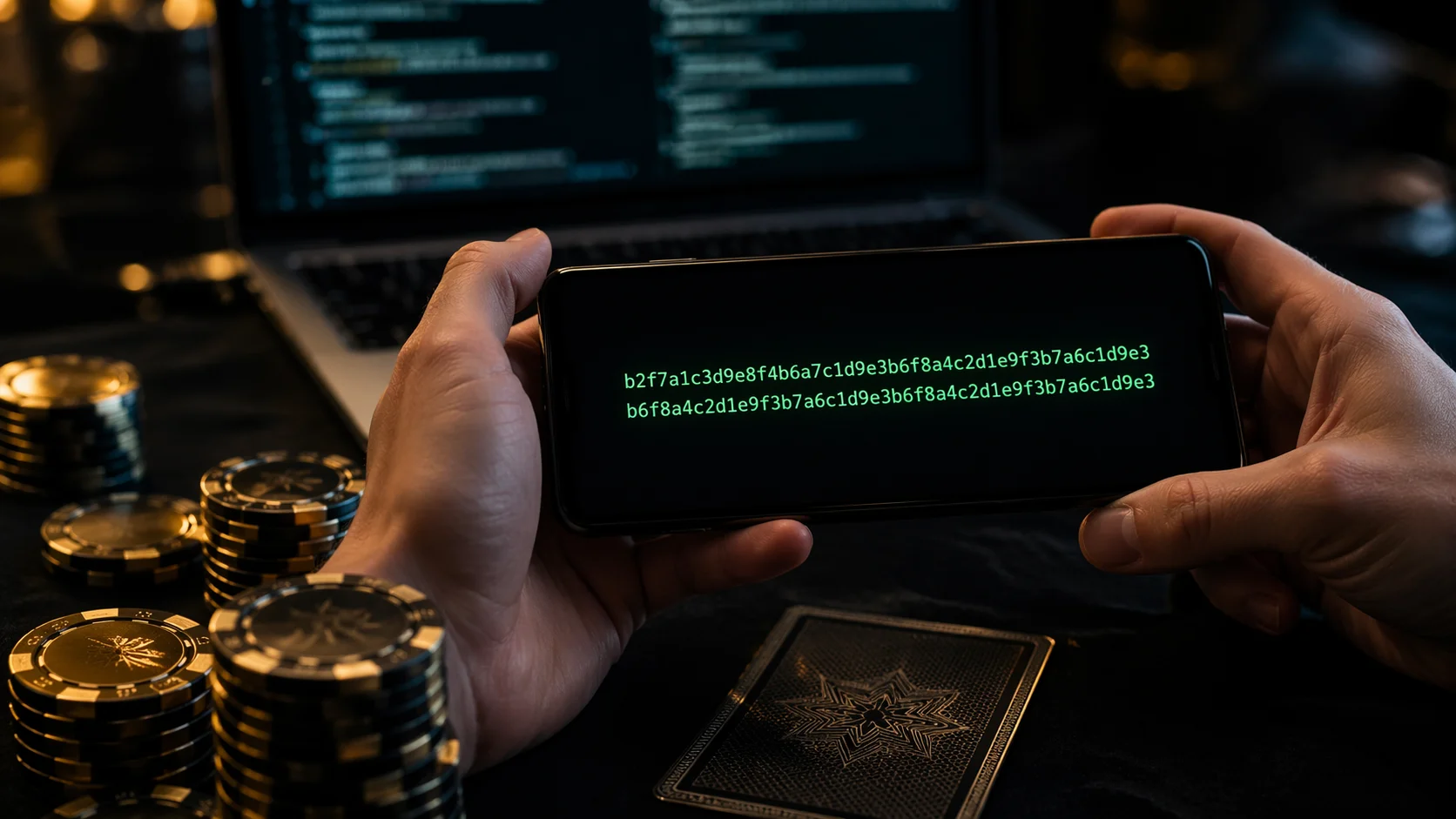
Provably fair is a cryptographic system where the casino commits to a random outcome before you bet (by showing you a SHA-256 hash), and then reveals the original number after the round so you can verify nothing changed. Think of it as a sealed envelope trick, except the envelope is math, and you can check the seal yourself.
| Element | Who creates it | When you see it |
|---|---|---|
| Server seed hash | Casino | Before you bet (hidden real seed) |
| Client seed | You or your browser | Before you bet (fully visible) |
| Nonce | Counter | Increments every round |
| Revealed server seed | Casino | After the round ends |
| Verification | You, using SHA-256 | Any time after the round |
The 30-Second Version
- Casino generates a secret
server_seedand shows you only its SHA-256 hash. - You pick a
client_seed(or your browser picks one for you). - You bet. The game combines both seeds plus a nonce to produce the outcome.
- After the round, the casino reveals the original
server_seed. - You run SHA-256 on the revealed seed. If it matches the pre-game hash, the casino didn't change it mid-game. Game was fair.
When You Need It (And When You Don't)
You need provably fair if you're playing Aviator, Crash, Dice, Mines, Plinko, Limbo, or any in-house crypto casino game. These are purely math-driven outcomes where a dishonest server can easily rig results.
You don't need provably fair for certified RNG slots from NetEnt or Pragmatic (already audited by eCOGRA), live dealer games (you watch the physical cards), or licensed sportsbooks where outcomes depend on real-world events.
How Provably Fair Works: The 3-Variable System
Every provably fair game in 2026, from Stake's Crash to Roobet's Mines, runs on three inputs: a server seed, a client seed, and a nonce. Understand these three and you understand 90% of the system.
Server Seed: What the Casino Hides
The server seed is a long random string generated by the casino's server. It's typically 32–64 characters of hex (like a7f3e2d8c4b1...). You never see the actual seed until the round is over.
Before you bet, the casino runs the seed through SHA-256, a one-way hash function, and shows you the output. The hash is like a fingerprint: if the casino changes even one character of the seed later, the fingerprint changes completely. You can't reverse-engineer the seed from its hash, but the casino can't swap the seed for a different one without you noticing.
In cryptography language, this is called a commitment scheme. The casino has locked itself into one specific random value, and you hold the receipt.
Client Seed: What You Control
The client seed is a random string you provide. Most games auto-generate one for your browser, but every provably fair casino lets you override it, change it to your birthday, your dog's name, anything.
Why does this matter? Without a client seed, the casino could pre-compute every future outcome using just the server seed. Your client seed is the anti-predictability layer. Once you change it, the casino can't know what outcome will come out even if they wanted to cheat.
Pro tip: change your client seed every time you rotate your server seed (every few hundred bets, or after any big win). It resets the pre-commitment and stops any timing-based exploits.
Nonce: The Anti-Repeat Counter
The nonce is just a counter, starts at 0 or 1, adds +1 with every bet on the same seed pair. Its only job is to make sure two bets with the same server_seed and same client_seed still produce different outcomes.
Without a nonce, your 2nd bet would hash identically to your 1st. With it, each bet's hash is unique.
The Hash Envelope Analogy
If the math still feels abstract, think of it like this:
The casino writes a random number on paper, seals it in a tamper-evident envelope, and hands it to you. You can't see the number (envelope is sealed), but you can tell if anyone opens it (tamper-evident seal). After the game, the casino opens the envelope. If the seal was still intact when it was opened, the number inside was always the number it claimed to be.
SHA-256 is the tamper-evident seal. The server seed is the number on paper. That's it, the rest is just math wrapping the same idea.
Step-by-Step: Verifying a Game Yourself
Every provably fair casino publishes a "Fairness" or "Verify" page. Here's the exact 3-step process, it works identically on Stake, BC.Game, Roobet, Rollbit, TrustDice, Primedice, and every other PF casino we tested in 2026.
Step 1, Grab the Pre-Game Hash
Open the game's Fairness or Provably Fair panel (usually a shield icon near the bet amount). Copy the Server Seed (Hashed) value to a notepad, this is your receipt. It should look like:
server_seed_hash: 9f8e7d6c5b4a3c2d1e0f1a2b3c4d5e6f...
Don't bet yet. This is the commitment.
Step 2, Play the Round
Set your client seed (or use the browser default). Place your bet. Play the round. Note the outcome (crash multiplier, card sequence, dice roll, slot symbols, whatever the game shows).
Step 3, Check the Revealed Seed Matches
Click Rotate Seed or Reveal Server Seed in the fairness panel. The casino now shows you the original, unhashed server seed:
server_seed: 5b4a3c2d1e0f1a2b3c4d5e6f9f8e7d6c...
Paste this into our provably fair verifier or any SHA-256 tool. If the SHA-256 output matches the hash you saved in Step 1, the seed wasn't changed. The round was mathematically fair.
To also verify the outcome itself, combine server_seed + client_seed + nonce, hash with HMAC-SHA256 or HMAC-SHA512 (the casino's docs tell you which), and the result should map to the same game outcome you saw. Detailed steps for each game type are in our how to verify provably fair walkthrough.
What the Hash Looks Like (Real Example)
Here's a real verification from a Stake Crash round (April 2026):
| Field | Value |
|---|---|
| server_seed_hash (before) | c2d8e5f1...b6a9 |
| client_seed | yourname2026 |
| nonce | 47 |
| server_seed (revealed) | a7f3e2d8c4b1...0921 |
| Crash point | 1.83x |
| SHA-256 of revealed seed | c2d8e5f1...b6a9 ✅ |
The "before" hash and the SHA-256 of the revealed seed are identical. Round verified.
Provably Fair vs Traditional RNG Casinos
This is where most players get confused. Both systems use randomness, the difference is who you have to trust.
| Casino Trust Model | Verifiability Score |
|---|---|
| Provably Fair (SHA-256) | 95 |
| Live Dealer (Camera Feed) | 65 |
| RNG + eCOGRA Audit | 45 |
| RNG Self-Certified | 20 |
| RNG, No Audit | 8 |
What eCOGRA-Certified Casinos Actually Audit
Traditional online casinos use RNG from providers like NetEnt, Pragmatic Play, or Microgaming. The RNG is audited once a year by labs like eCOGRA, iTech Labs, or GLI. They check that:
- The RNG passes statistical randomness tests (chi-square, serial correlation)
- Game RTP matches the advertised value
- The house edge is correctly configured
- No hidden "hot/cold mode" logic exists
It's legitimate. But it's a snapshot, auditors can't watch every single spin. You trust the audit, you trust the operator's deployment matches the audited version, you trust the lab.
Why Cryptographic Verification Matters
Provably fair flips the model: instead of trusting a snapshot audit, you verify your specific round. The casino can't lie about one bet and be honest about the next, every single round leaves a cryptographic fingerprint.
This matters most when:
- You just lost big and want to know why
- You suspect a session was abnormally hostile (regression to mean not kicking in)
- You're testing a new platform before depositing large amounts
- You're investigating whether a specific game variant is configured correctly
Trust Comparison: PF vs RNG vs Unaudited
| Feature | Provably Fair | RNG + eCOGRA | Unaudited |
|---|---|---|---|
| Per-round verification | Yes | No | No |
| Trust required | Minimal (math) | Medium (auditor) | Full (operator) |
| Works offline after round | Yes | No | No |
| Slot compatibility | Limited | Universal | Universal |
| Live dealer | Not applicable | Not applicable | Not applicable |
| Cost to implement | Low | High ($30k+/year audits) | None |
| Detects post-bet tampering | Yes | No | No |
Provably fair vs RNG certified goes deeper into when each model actually protects you.
Which Casino Games Support Provably Fair?
Not every game works with provably fair. The math only applies when the outcome can be pre-determined and committed before you bet. Here's the 2026 compatibility map.
Dice Games: Where It All Started
Primedice and Bitsler kicked off provably fair in 2012. Dice is the ideal PF game, one number between 0.00 and 99.99, generated from a single hash. Verification takes 3 seconds. Every crypto casino has a PF dice game.
Crash Games (Aviator, Rockit, Boom)
Crash games were the 2nd wave, exploding in popularity after Aviator launched on Spribe in 2019. The multiplier at which the plane "crashes" is derived from a hashed seed + nonce, mapped to a floor between 1.00x and theoretical infinity. Every major PF casino now has at least 2 crash-style titles.
Blackjack and Card Games
Provably fair blackjack works by hashing the entire shuffled deck order before the hand. You get the hash, play, then receive the full deck sequence afterward. BGaming and Evolution have rolled out PF card games, though adoption is lower than dice or crash.
Slots: Limited Support Only
This is where PF struggles. Slot math involves dozens of reel positions, cascading wins, bonus triggers, and free spins, all needing pre-commitment. BGaming has ~35 PF slots, but most major slot studios (Pragmatic, Hacksaw, NoLimit City) don't support it because it's easier to stay in the RNG+audit model.
If you're playing a slot labeled "provably fair" in 2026, 95% of the time it's a BGaming title or a smaller crypto-native studio.
Why Sports Betting Skips Provably Fair
Sports outcomes don't exist until the real-world event happens, so there's nothing for the bookmaker to pre-commit. The equivalent in sports betting is smart contract immutability (Dexsport, SX Bet) and published odds APIs. Different trust mechanism, same goal of transparency.
The Math Behind SHA-256 (Skip If You Hate Math)
You don't need this section to use provably fair. But if you want to understand why it works, here's the minimum dose.
Why You Can't Reverse a Hash
SHA-256 takes any input (a 3-character password, a 10 GB movie file, anything) and spits out a 64-character hex string. The formula is deterministic, same input always gives same output.
Simple version: hashing is like mixing red and blue paint to make purple. Given purple, you can't tell whether it was 50/50 red-blue or 40/60. The mixing loses information on purpose. SHA-256 is the same idea, but with math so strong that recovering the "red" and "blue" from the "purple" would take more energy than our sun will produce in its lifetime.
That irreversibility is what makes the pre-game hash a genuine commitment. The casino physically cannot change the seed later and produce the same hash.
Is Quantum Computing a Threat?
Short answer: not by 2030, probably not by 2040.
SHA-256 is resistant to Grover's algorithm, the main quantum attack on hashes. Grover's speedup would effectively turn SHA-256 into SHA-128 in security strength, which is still well above practical brute-force range. The quantum computers that could plausibly break SHA-256 (millions of qubits, sustained coherence) don't exist and aren't on any 2026 roadmap.
The real risks to provably fair come from implementation bugs (biased seed generators, predictable client-side RNG), not from the underlying cryptography.
Common Misconceptions and Red Flags
The "provably fair" label is, like most marketing claims in gambling, frequently abused. Here's what to watch for.
"Provably Fair" Doesn't Mean "Secure"
Provably fair proves the game wasn't rigged. It doesn't protect you from:
- Casino insolvency or exit scams
- Withdrawal delays
- Bonus terms traps (check our bonus abuse detector)
- Geolocation lockouts on withdrawal
- KYC document abuse
A provably fair casino with a bad license can still steal your deposit. Treat PF as a game integrity feature, not a platform trust feature.
The Biased Seed Generation Trick
The weakest link in provably fair is how the casino generates the server seed. If they use a predictable or biased pseudo-random generator, the system still passes SHA-256 verification, but the outcomes are no longer actually random.
Good casinos publish the seeding algorithm and use auditable entropy sources (hardware RNGs, blockchain beacons like drand). Shady casinos just say "generated securely" with no details.
How to Spot Fake PF Implementations
After auditing 40+ casinos claiming PF in 2026, here's the red-flag checklist:
Red Flags Checklist
- No way to change your client seed
- Server seed rotation requires customer support approval
- Verification page requires login (legit PF works anonymously)
- Hash shown uses a custom algorithm ("SHA-like") instead of SHA-256
- No nonce counter visible
- Fairness page is just a marketing explanation with no actual tool
- Only a specific handful of games are labeled PF (cherry-picking)
- No technical documentation of the seeding algorithm
If 3+ of these apply, the "provably fair" claim is decorative. For legitimate verification, stick to casinos with open-source PF libraries like those documented in our client seed vs server seed guide, or bitcoin-native PF games where the chain itself is the audit trail.
The technical RNG underpinnings are broken down further in provably fair RNG explained if you want the cryptographic deep dive. For broader casino transparency context, the house edge primer shows why even a fair game still has a mathematical advantage for the house.
Ready to try it on a real casino? Our provably fair directory lists every venue that actually publishes the three variables we just walked through, skip any site that does not expose the seed hash upfront.
Frequently Asked Questions
Provably fair gambling is a cryptographic system that lets you mathematically verify a casino didn't cheat on any single round. The casino commits to a random seed before you bet, shows you only its hash, then reveals the original seed after the round. You run SHA-256 on the revealed seed — if the hash matches, the result was locked before you played.
In Aviator, provably fair means the crash multiplier (where the plane explodes) is generated from a hashed server seed, your client seed, and a nonce — before you bet. After the round, you can re-hash the seeds and confirm the crash point wasn't altered. Stake, BC.Game, and 1win all publish verification pages for their Aviator rounds.
Some Roobet games are provably fair (their in-house Roulette, Crash, Mines, and Towers), but their slot library from third-party providers like Hacksaw Gaming and Pragmatic Play uses standard RNG audited by iTech Labs — not provably fair. Check the game's info panel before assuming verification is possible.
The provably fair setting is a menu inside your game (usually a lock or shield icon) where you can view your current server seed hash, set your own client seed, rotate seeds, and access the verification tool. Changing your client seed before a bet guarantees the casino can't pre-compute a losing outcome based on your old seed.
Copy the server seed hash you received before the round, the revealed server seed after the round, your client seed, and the nonce. Paste the revealed seed into any SHA-256 tool (or our verifier above). If the output matches the original hash — and the combined seed hashes to the same game outcome — the round was fair.
No. Both use random number generators, but RNG-only casinos keep the process closed and rely on third-party audits (eCOGRA, iTech Labs, GLI). Provably fair adds a public cryptographic receipt for every single round — you don't have to trust the auditor because you can verify outcomes yourself.
Not in a practical sense. Breaking SHA-256 requires either finding a hash collision (cryptographically infeasible with current or near-future computers) or stealing the server seed before the round ends. The realistic attack isn't hacking — it's a dishonest casino using biased pseudo-random generators for the server seed, or refusing to rotate seeds when you request it.
No. Provably fair only proves the casino didn't alter the result after your bet. The house edge is still set by the game rules. A provably fair blackjack paying 6:5 on naturals has a worse edge than a regular 3:2 traditional blackjack. Fairness of outcome process ≠ fairness of payout structure.
The biggest provably fair casinos in 2026 are Stake, BC.Game, Roobet (partial), Rollbit, TrustDice, Primedice, Cloudbet, and BetFury. Most are crypto-first and operate under Curacao licenses. Traditional fiat casinos almost never offer provably fair because their slot providers (NetEnt, Pragmatic) don't support the cryptographic hooks.
Not always, but usually yes. Provably fair emerged from the Bitcoin ecosystem, so most PF casinos are crypto-native. A few accept fiat via Moonpay or direct card deposits, but the game library and the PF verification remain the same regardless of deposit method.
SHA-256 is a one-way math function that turns any text into a fixed 64-character fingerprint. Same input always gives the same output, but you can't reverse the fingerprint back to the original text. That's why casinos can show you a hash as proof of commitment — they can't change the underlying seed without producing a different fingerprint.
Sports outcomes are decided by real-world events (a football game, a horse race) that happen after you bet — so there's nothing for the casino to pre-commit and hash. Provably fair only works for games with a pre-determined random outcome. For sports, the equivalent transparency is on-chain smart contracts and open bookmaker odds data.
Yes, everywhere online gambling is legal. Provably fair is a technical transparency feature, not a regulatory category. Most PF casinos hold Curacao licenses, which regulators accept in jurisdictions like Canada, Germany, Brazil, and most of the EU. PF doesn't replace licensing — always check both.
The server seed is generated by the casino and hidden until the round ends (you only see its hash). The client seed is generated by you or your browser, and you can change it anytime. Combining them with a nonce produces the final outcome. The client seed's job is to stop the casino from pre-computing results — if you change it, they can't know what comes next.
You change the outcome — but not in your favor. Changing your client seed shifts which of the pre-hashed server-side outcomes will apply to your next bet, but you can't predict which shift gives a better result because you don't know the server seed yet. It's a fairness mechanism, not a strategy edge.

Evgeniy Volkov
Verified ExpertFullstack developer with a background in mathematics. I build the calculators and game-style tools on ToolsGambling with Pixi.js and modern web tech, and every result uses transparent probability formulas you can verify yourself.